

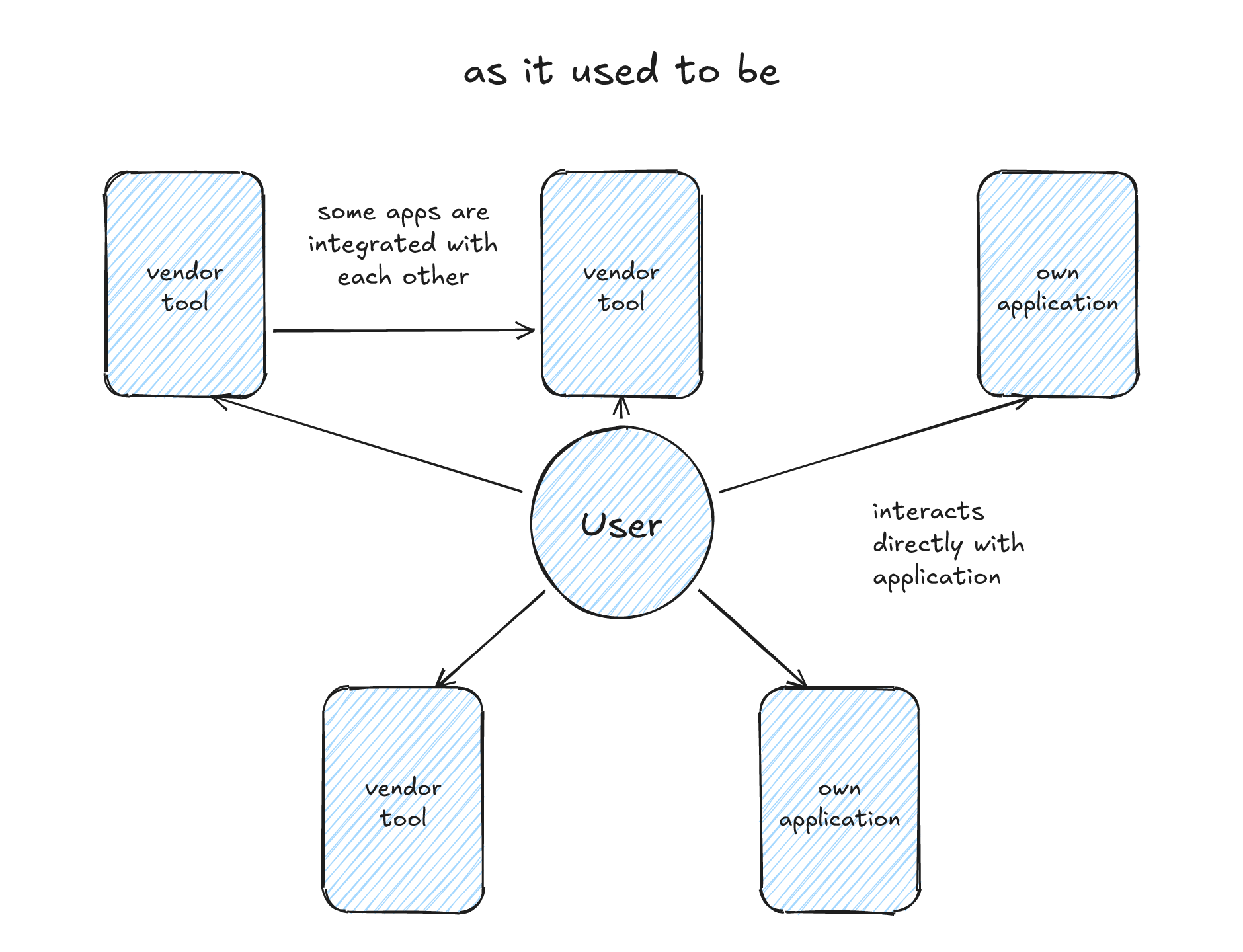
Working in B2B GTM used to be about knowing how to use a lot of different tools. There is a tool for everything: running your SEO analysis, scheduling posts on your socials, enriching your leads, finding look-a-likes, building your forecast, or assessing your account risk.
Tech stacks of revenue teams grew into an ever wider jungle. And each tool brought with it a new GUI to learn: new super powers to leverage and new limitations to be frustrated about. And then there was Zapier, which, with enough patience and persistence, allowed you to glue everything together.
Working in B2B GTM was about building fluency in navigating a huge tool landscape, knowing what to use when and how to manually or semi-automatically stitch it together. Entire functions have been built around navigating tools, like CRM admins.
AI has flipped this equation.
The future of the GTM tech stack: APIs only
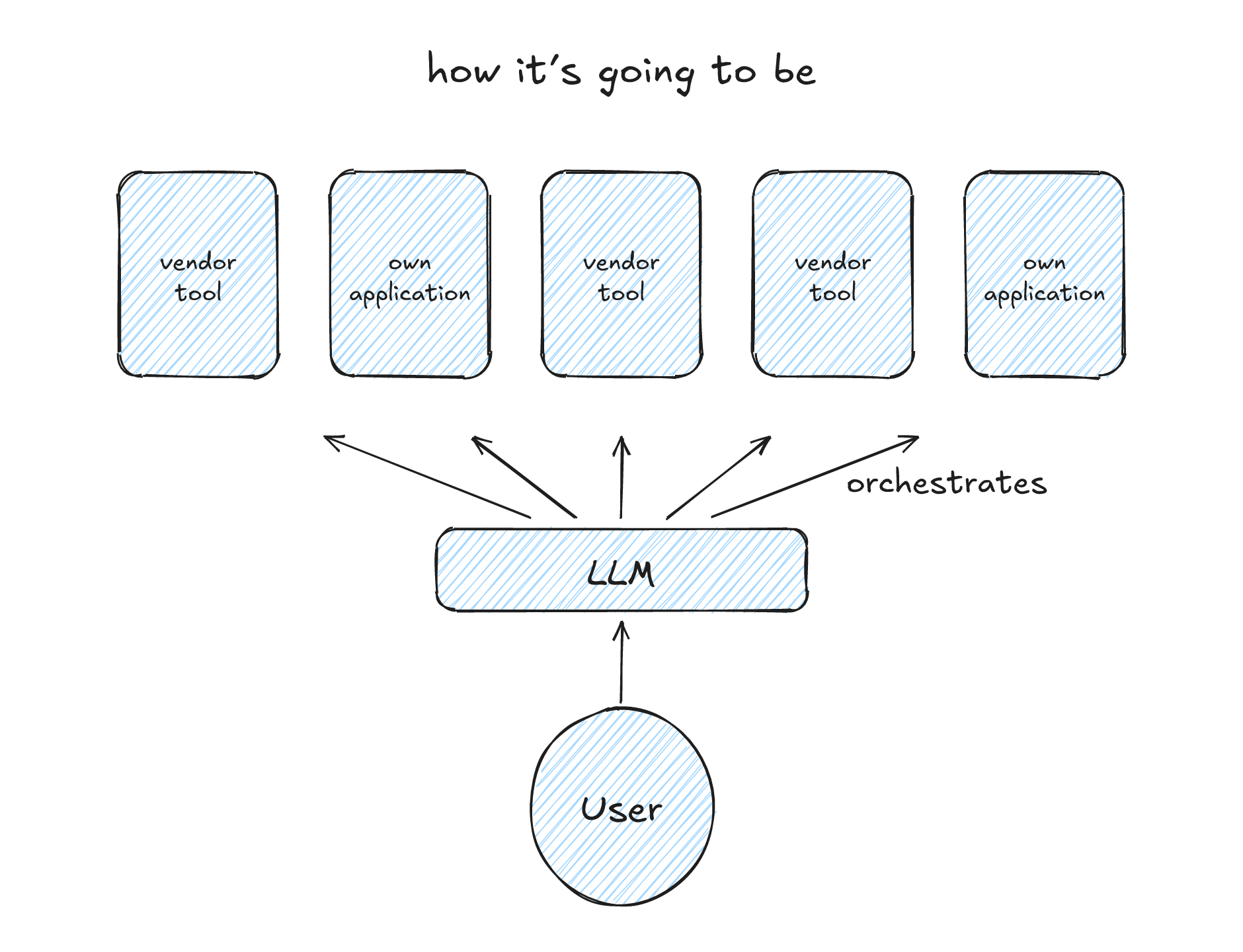
The future of GTM will place you at the center of a tool landscape which you orchestrate and steer using an LLM. The main interface for you will be the LLM. All other tools you need to execute certain workflows will be communicating with each other via API. Your LLM will do the same.
This does not mean there won’t be a user interface as we know it today. There may be things “you want to look at”: Like a calendar view for a campaign planning, a heat map of accounts across Sales territories, or a cohort analysis showing customer usage.
But this user interface will mainly serve the purpose of you getting an orientation on things, obtaining an overview. The orchestration, the instruction, the steering will happen with the LLM. Not in the configuration of a tool.
What these individual tools will expose is their API documentation. They will allow you to communicate with them via API and be fully flexible on what data to send and receive and when. What will be needed for you is to build APIs fast and reliably using your LLM. For everyone working in GTM teams it will be essential to know how to orchestrate such a tech stack.
This goes way beyond just letting Claude do what the likes of n8n do for you now.
The ability to let software solve your problems
B2B GTM is all about processing information, and triggering action steps based on this information. Take buying intent signals as an example: someone posted about the opening of a new factory, you reach out because you help companies set up the logistics.
In its core, these workflows are simple, but to be able to trigger the right next step, you need to process and interpret this data, and you need to do this efficiently. This may mean you want to identify the person posting about this factory opening announcement, then checking their employer against your ICP, gathering whether you had touchpoint with this lead in the past, and determining whether an existing outbound motion already touches upon her or him.
You can do all these steps one by one, with the LLM at hand to speed up your work. The more efficient way will be to write a dedicated software application (with an LLM!) that lets you orchestrate this fast, or does parts of the work - like the ICP check or outbound sequence overlay - already for you, handing you the analysis result on a Silver Platter. The Silver Platter is the low-friction output you need, customised specifically for your case.
The workflow architecture you build in such cases is not mere data flows from one tool to another. It is interpreting data points at certain steps in the workflow, combining them, and presenting them to you as a human in a manner easily digestible for you. This will be a combination of your own developed application and an orchestration of API calls to external tools. At the center will be a team of humans that makes design decisions on what type of data points they need, and how to interpret these.
It is this Silver Platter that GTM teams need to work at scale, and the answer to this lies in their ability to develop their own applications.
What your Silver Platter looks like
There is no general answer on how this Silver Platter looks like. What you need in terms of such flows is very custom to your business model, to your value proposition and your target persona. It may be a dedicated scraping of compliance reports on a quarterly basis. It may be analysis of weather patterns, cross referenced with cargo rates. It may be monitoring of LinkedIn posts of selected accounts, additionally checked for sentiment.
Only you can say what your Silver Platter looks like.